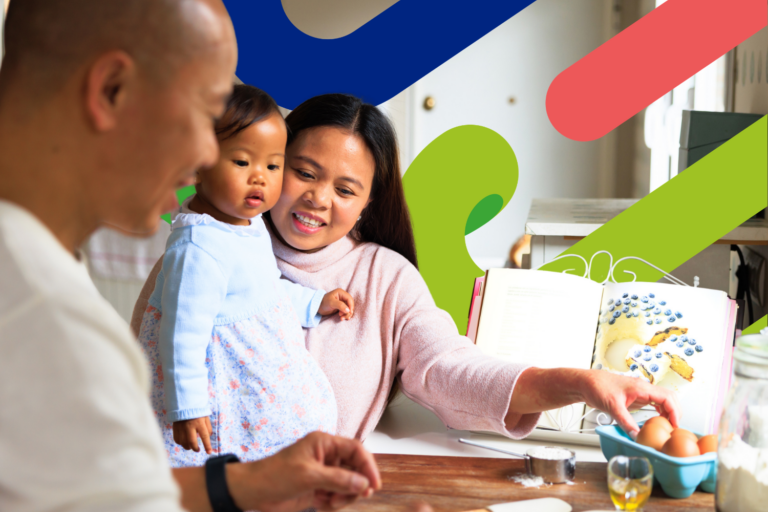
WIC is here to support the health and well-being of Black families through culturally specific breastfeeding and nutrition support, healthcare referrals, community events, and more!
On Wednesday, April 15, the National WIC Association hosted an Instagram Live event on the WIC: You Got This! Instagram page to celebrate Black Maternal Health Week! This was an easygoing, conversational way to connect with Black maternal health and breastfeeding experts as well as fellow parents who tuned in from across the country.
Our panelists and moderator included:
Breanna Kuimi, IBCLC, CHN, Panelist—Breanna has been a nurse for a decade, and she’s also an International Board Certified Lactation Consultant (IBCLC) and CHN (certified holistic nutritionist). Breanna is a mom of 4, including twin babies, a woman of God, and CEO of Anew Life, a nonprofit based in Los Angeles that offers postpartum support services.
Micia Eddins, MPH, IBCLC, CD, CHW, CLS, Panelist—Micia is a Detroit-based public health innovator, International Board Certified Lactation Consultant (IBCLC), certified doula, and Community Health Worker. She is the Founder & CEO of J.O.B. Lactation and the visionary behind groundbreaking initiatives advancing maternal health equity.
She is the creator of The Real Breastfeeding Experience, an immersive Virtual Reality (VR) education platform designed for use with Oculus headsets. The program provides interactive, 3D learning on breastfeeding anatomy, milk production, latch technique, and infant stomach size, transforming how maternal health education is delivered in both clinical and community settings.
Micia is also the Executive Producer of The Real J.O.B. – Joys of Breastfeeding, a powerful documentary amplifying real stories of labor, birth, and breastfeeding advocacy.
Dimond Preston, Moderator—Dimond is a Senior Communications Associate at the National WIC Association (NWA). She works on the Communications Team, focusing on marketing and content creation for NWA products, events, and newsletters. Dimond also manages NWA’s website and the WIC Hub, a collection of resources and research about WIC.
Dimond holds a Master of Public Health in Public Health Communication and Marketing from George Washington University and a Bachelor of Science in Health Science from Virginia Commonwealth University. Her interests and passions include using public health communications to advance health equity, particularly in areas such as Black maternal health, health disparities, and food security. Dimond was also a WIC baby, which inspires her work at NWA today. She joined NWA in May 2024.
Q+A with our Instagram Live Panelists
Dimond: Can you share a little bit about your connection to WIC?
Micia explained that she began working for WIC in 2013 as a nutritionist. In 2016, she became a breastfeeding coordinator after completing lactation specialist training. She later pursued her IBCLC certification in 2018. She worked with WIC for nine years before transitioning to her current role as the Regional IBCLC for the State of Michigan. She continues to support WIC peer counselors across the Detroit metro area and credits WIC with shaping her professional journey.
Brianna shared that her connection to WIC began through her own lived experience. Seven years ago, a WIC IBCLC supported her through her first breastfeeding journey, helping her exclusively breastfeed her son. That experience inspired her to pursue lactation education and eventually become an IBCLC. She credits WIC with motivating her to advocate for breastfeeding families and shaping her career path.
Dimond: WIC supports breastfeeding parents with the help of lactation specialists like IBCLCs and breastfeeding peer counselors. Can you share more about what being an IBCLC means?
Brianna described IBCLCs as experts in infant feeding who support families with everything from basic latch issues to complex medical challenges such as cleft palate. She emphasized that parents rely on IBCLCs for accurate, evidence‑based guidance on infant nutrition.
Micia added that becoming an IBCLC represents the highest level of professional training in lactation. She noted that even with extensive knowledge, becoming a mother herself taught her humility, because breastfeeding challenges can still arise. She explained that WIC played a major role in helping her develop cultural competence and sensitivity, which are essential when working with diverse families.
Dimond: Brianna, through your work with your nonprofit organization, Anew Life, what gaps in postpartum care are you seeing most often for Black families?
Brianna explained that many Black families experience a lack of representation among healthcare providers, which often leads to feelings of not being heard or understood. She frequently hears from families who feel their concerns are dismissed or minimized. She also sees a lack of postpartum support systems, especially for families without extended relatives nearby. Many parents struggle without help for basic needs such as meals, household care, or emotional support.
She also noted that Black mothers often return to work earlier than mothers of other racial groups, which can disrupt breastfeeding. Additionally, she sees inconsistencies in breastfeeding education among pediatric providers, which can lead to conflicting advice. Through her nonprofit, she works to fill these gaps by providing free postpartum doula support, breastfeeding consultations, meal preparation, and household assistance.
Dimond: Micia, your Virtual Reality education platform, The Real Breastfeeding Experience, is such a unique and important tool. What inspired you to create it, and how have you seen it impact learning?
Micia explained that culturally responsive care begins with understanding the unique challenges Black mothers face. She emphasized the importance of meeting mothers where they are and recognizing that breastfeeding success is influenced by emotional, physical, and psychological factors. She believes that trust and rapport are essential components of effective lactation support. She created The Real Breastfeeding Experience because traditional breastfeeding education often feels like a one‑sided lecture.
She noticed that many parents struggled to retain information, which made breastfeeding more difficult once the baby arrived. Her VR platform allows parents to visually explore breastfeeding anatomy, hormones, latch mechanics, and milk production in an immersive way. Her approach encourages dialogue, curiosity, and deeper understanding. She also noted that support partners benefit from the experience, making them better equipped to encourage mothers during challenging moments.
Dimond: This year’s Black Maternal Health Week theme is Rooted in Justice and Joy. What does being rooted in justice and joy mean to you and the work you do in your community?
Brianna shared that being rooted in justice means advocating for oneself and others, especially those who may not have a voice. She believes it is important to stand up for Black mothers who experience inequities in healthcare. She also reflected on her own twin birth experience, which required strong self‑advocacy. For her, joy means reclaiming peace, happiness, and empowerment—especially in a world where Black joy has often been diminished or dismissed.
Micia explained that joy is deeper than happiness because it is lasting and cannot be taken away. She believes breastfeeding can be a profound source of joy and strength. She also emphasized that justice involves advocating for the needs of the community. Her organization’s name, JOB (Joys of Breastfeeding), reflects her belief that joy should be a permanent part of life and motherhood.
Audience Q&A
Question from an Audience Member: How can a husband or partner support their wife while breastfeeding?
Brianna:
- Bring the baby during night feedings
- Help with bottle prep
- Take over household tasks
- Offer emotional support and encouragement
- Support her through supply fluctuations
Micia:
- Encouragement is everything
- A supportive partner increases breastfeeding success
Question from an Audience Member: What challenges have you faced in breastfeeding? What were your greatest successes?
Micia:
- Challenge: Understanding how much baby needs without relying on pumping
- Challenge: Pain and exhaustion
- Success: Reaching out to an IBCLC and learning proper positioning and expectations
Brianna:
- Challenge: Tongue tie, bottle refusal, low supply, eczema, growth spurts
- Success: Overcoming these challenges and successfully breastfeeding all four children
- Success: Twins have been surprisingly smooth with no latch issues
Watch and share the post-event Instagram reel and follow us to stay tuned for future events
Follow us (@WICYouGotThis!) on Instagram to watch the full recording of this year’s #BlackMaternalHealthWeek Instagram Live!
Author
Mariah Cowsert
Mariah Cowsert is a Senior Communications Associate at the National WIC Association. She has 9 years of experience in public health communications, with her work ranging from direct social service and affordable housing organizations in DC and her home state of Michigan, to supporting sexual and reproductive health education initiatives at a national non-profit in Baltimore. As someone who grew up in a low-income household in rural Michigan—she knows firsthand that when families have access to quality, healthy foods regardless of their income or zip code; they can not only survive but thrive.